Statement
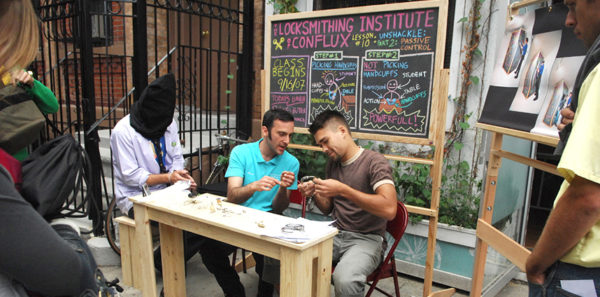
Photo: Jennifer Altman, New York Times, 09/18/07
Through performance, sculpture, installation, video, photographic documentation, viewer interactions, and social practice I create opportunities for audiences to experience very private moments in very public situations. Thematically, my projects address ideas of service, perception, liberation, privacy, power, and labor by utilizing the under-appreciated aspects and roles of human existence –such as furniture, locks, teachers, and service professionals– as raw material to craft my artistic experiences. I have worked professionally in roles such as a cabinet maker, fine-dining busboy, production assistant in adult films, and yoga teacher, and mined these job skills and situations as a platform from which to produce artistic work. This includes my best-known body of work, produced out of the nine years that I spent working as a professional locksmith. The artwork that comes as the result of my different employment/research projects changes, but from the time I spent working as a locksmith, I created a conceptual project called The Locksmithing Institute (February 2005-present). This “school” traveled to different public places and aimed to teach anyone interested the different themes or skills related to locksmithing. Initially, the lessons were a derivative of the physical activities that I executed while working as a locksmith, such as picking locks or making keys. Each class consisted of both a mechanical lesson –for instance, “How to pick a lock”– and also an embedded conceptual lesson. For example, in order to pick a lock, a person needs to use “pressure” and “manipulation” in order to coax the device open. It is not without coincidence that those words –with powerful cultural histories– are used in conjunction with that lockpicking process. It was up to participants whether they wanted to discuss this connection between theory and practice or to just learn how to pick a lock. I would develop the lessons in four or five parts and let participants dictate how much or how little they got out of the experience. This multi-tiered approach allowed me to cater to children, adults, art-experts, and/or art-novices simultaneously in a seamless fashion.
My work has been displayed nationally and internationally in performance, gallery, public, and museum contexts and has been reviewed in Art Forum, The New York Times, and The Los Angeles Times. Selected exhibitions include Conflux, New York City; Charlie James Gallery, Los Angeles; 826 Valencia Street, San Francisco; Portland State University, Portland, OR; and S.M.A.K (Municipal Museum of Contemporary Art), Ghent, Belgium. In 2010 I was an artist in residency with Vooruit Center for the Arts in Ghent, Belgium. Two of my photographs are housed in The Berkeley Art Museum’s permanent collection. From March 2018-September 2019 I was an artist in residence at Grand Central Art Center at California State University, Fullerton funded through a grant from the Warhol Foundation for Visual Arts. In 2002 I received my BFA with honors from the New Genres department of The San Francisco Art Institute. In 2021, I earned my MFA with honors from the University of California, Santa Barbara as the Regents Fellow in the Department of Art and was awarded a paid post-graduate Teaching Fellowship after graduation.
-Excerpt from Artweek:
“…There were a lot of photographs in Close Calls 2007. But-how to put this elegantly? -most failed to distinguish themselves. The exceptions were stunning works by Lucas Murgida…While the depicted goings-on did seem laced with many allegorical portents of a surrealist provenance, the photos themselves had a composed stateliness rarely seen in most photographic documentation, and seemed to have knowing relationship to the ways that high-renaissance painters staged their own allegorical figures.”
Close Calls: 2007 at Headlands Center for the Arts
By Mark Van Proyen
Artweek, March 2007, Volume 38, Issue 2
